Tariffs: Tariff-ic or Tarri-ble?

In 2025, the U.S. government announced a variety of tariffs on goods imported into the U.S. from other countries. The way tariffs work is that when goods are imported into the country, the company importing them pays a percentage of the cost of the goods to the government. So, a tariff is just another type of tax. An imported good that costs $1000 with a 30 percent tariff rate causes the importing company to pay $1000 to the foreign company for the product, plus $300 to the U.S. government. Will the new price of the good to the consumer be $1300? Or will the importer or producer eat some of the tariff, reducing their profit margin? That is a complicated question, as we will see. But let’s first look at the benefits of international trade and why it occurs.

Economists generally think international trade makes everyone better off because of a concept called comparative advantage. The idea is that your own country is relatively better at producing certain goods and services, and other countries are relatively better at producing other goods and services. These days, U.S. firms have a comparative advantage in tech, banking, and accounting. Other countries have a comparative advantage in producing goods—China and other countries for producing clothes and toys, Europe for producing wine and chocolate, Japan for producing steel and autos, and so on. So, it makes sense for each area of the world to produce the goods they are best at producing, and to trade with others. When tariffs are imposed by a country, the tariffs change the prices to consumers, distorting their decisions, and reducing the benefits brought by trade.

Will anyone benefit from tariffs? The main benefits of tariffs go to the domestic workers and firms in the industry that is subject to the tariff, plus the U.S. government, which gains tariff revenue. When foreign goods become more expensive, domestic firms’ sales can go up, or they can raise their prices, or both. Sometimes, tariffs imposed worldwide on a product can lead to new production within the country that imposed the tariff, which is what happened with washing machines in 2018 when firms started producing more washing machines in the U.S.

Who bears the cost of tariffs? In the first five months of 2025, U.S. tariffs brought in over $60 billion to the U.S. government, which is roughly 0.6% of GDP (about $10 trillion) over that same period. Economists have tried to see how tariffs affect prices and profits, and doing so is complex. First, the net price to consumers (or businesses, in the case of tariffs on goods used in production) may be higher, so they buy less of the good with the tariffs. They substitute to other goods, perhaps those without tariffs, and they just spend less because of the higher price as their purchasing power shrinks. Second, the reduced demand for the product affects the suppliers. They might decide to reduce prices because of the lower demand for their product, so their profit margins decline. Similarly for the importing company. Thus, the cost of the tariff will be borne by demanders, suppliers, and import firms (as well as retailers, and everyone else involved in the supply chain). However, if a tariff on a product is imposed on just one country (China, for example), production may simply shift to another country (such as Vietnam).

Do the benefits to a country from imposing tariffs exceed the costs? Or do the costs exceed the benefits? In theory, if a government has a lot of information on supply and demand and how both respond to tariffs, it could find the optimal tariff that would benefit the country, though at the expense of people in other countries, and the costs to those people exceeds the benefits to the country that imposed the tariff.

Then, there’s the issue of retaliation. When the U.S. imposes tariffs on products imported from other countries, those countries might retaliate and impose tariffs on goods and services that they import from the U.S. In that case, everyone is worse off, and the gains from comparative advantage are lost. Despite the worldwide decline in tariffs over the past 80 years, both the U.S. and other countries still protect certain products from foreign competition. The U.S. has high tariffs on pickup trucks from other countries to protect large U.S. automakers from foreign competition. The tariff on pickup trucks was originally a retaliation by the U.S. for a tariff that Germany placed on imported chicken, pricing U.S. chicken out of their market.

As it turns out, many economists and politicians have judged the benefits of tariff reductions to exceed the costs. That is why the U.S. government has been the world’s leader in reducing tariffs all over the world from the 1940s to the 2010s, under the principle of reciprocity—we reduce our tariffs on their goods if they reduce their tariffs on our goods. That led U.S. tariffs on imported goods to decline from about 15 percent on average 100 years ago to about 1.5 percent in 2024, with a similar decline on foreign tariffs on U.S. goods.

The most complex issue with tariffs is their impact on the overall balance of trade. The U.S. has a huge trade deficit with the rest of the world. We import much more than we export, with an average trade deficit of 3 percent of our GDP over the past decade. Countries that sell many goods to the U.S. spend the funds they earn to buy U.S. financial assets. The danger from higher U.S. tariffs is that it may reduce foreigners’ willingness and ability to buy our bonds, especially U.S. government bonds, making it more expensive to finance our huge U.S. government budget deficit. Of course, that could also affect the value of the dollar against other currencies, leading to even further impacts on trade between countries.

Do tariffs help create domestic jobs? The answer is yes, but at a high cost to consumers. A great example is the case of washing machines in 2018. The U.S. imposed a tariff on imported washing machines, and U.S. prices for washing machines rose by about the amount of the tariff, roughly $90; and since dryers are a complementary good, their prices went up by about the same amount. Most importantly, Samsung, LG, and Whirlpool increased their production in the U.S., so the goal of the tariff seemed to be achieved. With 1,800 new jobs created, the policy was a success. But the price was high. The U.S. government received $82 million annually in additional tariff revenue and consumers paid $1.5 billion in higher prices. That’s a net cost to the economy of $815,000 per job created per year.

The case against tariffs might seem clear cut, but there is one major issue that is unresolved in support of tariffs and against free trade. Because of comparative advantage, many companies in industries like steel and textiles have shut down plants in the U.S. and relocated to other countries. Labor is cheaper there (even though foreign workers are not as productive as U.S. workers), so they start producing their products in other countries like China or Vietnam. But what about the U.S. workers left behind? Shouldn’t we care about them? The answer is: yes, we should. In fact, it is explicit in U.S. law that the government can provide assistance to communities left behind. So, when manufacturers abandoned cities in the U.S. Midwest, and they became centers of the opioid crisis in the U.S., the government should have come in and provided training and jobs to those displaced workers. But the government failed those workers completely and left them to suffer on their own. Targeted programs to help displaced workers are needed as a complement to free trade, to prevent societal disruptions.

In summary, tariffs are a complicated subject. The bottom line is that historically, the U.S. government has been a champion of lower tariffs across countries on a reciprocal basis. Lower tariffs are economically efficient and make consumers all over the world better off. Higher tariffs on particular products help certain workers and firms at the expense of others. A better solution to help displaced workers is for the government to help them out directly, rather than using tariffs, which distort economic decisions.

Data Watch: Why Do Economic Data Get Revised?

Data on the economy are not precise and get revised over time. Why? The early estimates of economic data like GDP are initially released based on partial information. We only get more complete information later—sometimes much later.

Government statisticians face a tradeoff between timeliness and accuracy. If the government wants to release only GDP numbers that are very accurate, it would have to wait for a long time before releasing any data at all. For example, a fairly accurate measure of GDP for 2024 will be released by the government statistical agency (the Bureau of Economic Analysis, BEA) at the end of September 2025. That’s a long time to wait to get a comprehensive measure of how much output was produced by the U.S. economy. Instead, we got a first estimate of GDP for 2024 in January 2025, and it was revised in February and again in March. But more complete source data are available by the end of September, and the number for 2024 that will be released then will be much more accurate. For that reason, it is crucial that policymakers understand the process of producing the data.

Recently, some policymakers have focused on the revisions to the employment data for May and June 2025, and wondered if they might have been manipulated for political purposes. But the data on employment are routinely revised, sometimes by a significant amount. We need to remember that those data are monthly, and the size of the data revisions was puny, because monthly movements in the data are small. The revisions in question were less than 0.1 percent of the total number of people employed. However, it is true that the revisions were relatively large, compared with other revisions to the number of people employed at firms. Only 4 percent of all revisions from the first release to the second release since 1964 were larger in magnitude than the revision of the June value. Only 7 percent of all revisions from the first release to the third release since 1964 were larger in magnitude than the revision of the May value.

But I wonder why people focus so much on monthly data in the first place. Monthly data are very noisy—our measurement is not precise and many random things happen in a month. It would be preferable to look at quarterly data or even annual data. When you average a data measure over longer periods, you smooth out the noise and get a more precise measure. With quarterly averages, 15 percent of all revisions from the first release to the third release were larger than that in the second quarter of 2025; while 17 percent of all revisions from the first release to the second release were larger than that of the second quarter of 2025.

So, our analysis of past revisions going back to 1964 suggests that the revisions that just happened to the employment numbers were larger than normal, but far from the largest, and many revisions in the past have been even larger.

Even more importantly, the fact is that government data agencies follow strict rules for how they conduct their work. They follow well-established procedures for how to deal with the raw source data they get and then generate from those incomplete numbers the overall values of the data series being produced. If you look at when the largest revisions to GDP and employment have occurred in the past, you see that unusual events led to large revisions. The largest revisions to the GDP data occurred in the stagflation of the 1970s, the 9/11 attacks, the financial crisis in 2008, and the pandemic in 2020. Large employment revisions occurred in similar time frames. It is possible, and worth further exploration, that the cuts to government employment in 2025 by DOGE were not counted well by the BLS. If so, perhaps some modification of BLS procedures could be in order. But it is difficult for a government statistical agency to anticipate that type of shock, and modify its procedures to account for it, before it happens. In my studies of data revisions over the past 25 years, I have learned a lot about the data production process. The key thing to remember is that if data were not revised, the data would just be wrong forever. Data revisions improve the precision of the data. We are fortunate that U.S. data are among the best in the world, and always getting better, especially after they are revised.

Data Watch: Introduction to Inflation

Prices of the goods we buy seem to be getting higher and higher every year. Inflation is caused when the central bank (the Federal Reserve in the United States) allows the amount of money in circulation to grow too fast, or equivalently, if the central bank sets interest rates too low. Inflation causes the value of your money to decline, so you bear a direct cost.

What Does a Dollar Buy Today?

When inflation occurs, prices of goods rise, on average. So, a dollar buys less than it used to buy. How much is a dollar worth today, compared to the past?

As the table suggests, a dollar buys nowhere near what it used to. It now takes $8 to buy what $1 bought in 1962.

To get an idea of how much prices have changed in a year, we can calculate the inflation rate as the percentage increase in prices from one year earlier. The graph below shows the results of this calculation from 1960 to 2025.

In the chart, you can see that inflation in the early 1960s was very low. But inflation began to rise steadily in the late 1960s and into the early 1970s. Then, from 1974 to 1975, inflation jumped to double-digit levels. Inflation dropped for a short time later in the 1970s, but jumped up again in 1979 and 1980. Inflation began to decline in the early 1980s, rose a bit in the late 1980s, and then declined to below 2 percent in the 1990s. The 2000s saw volatility in inflation, though on average inflation remained fairly low. The inflation rate was negative for a short time in 2009, mainly because of a sharp decline in prices during the financial crisis. In the 2010s, the inflation rate remained below 2 percent, which is sometimes thought to be the optimal rate of inflation. But in March 2021, inflation jumped up sharply, as the effects of the pandemic subsided. Today, the inflation rate is about 2.5 percent.

What Causes Inflation?

In the short run, inflation can rise or fall from a number of factors, especially from temporary increases in food or energy prices. But in the long run, it turns out that only an economy’s central bank determines the inflation rate.

Historically, most of the periods in which a country has allowed inflation to reach high levels, as in the United States in the 1970s and early 1980s, were periods in which the central bank of the country allowed the amount of money in circulation to grow at a faster pace than it should have. The central bank is the entity that is in charge of distributing money in a country; in the United States, the central bank is the Federal Reserve, called the Fed for short. In the 1970s and early 1980s, the Fed made severe errors in judgment. The Fed’s leaders thought that the Fed should increase the money supply at a faster pace because the economy was growing slowly. But the increase in the money supply caused high inflation and did not help the economy grow faster at all.

Here is a plot of the relationship between the growth rate of the money supply and the inflation rate from 1960 to 1979. As you can see, increases in money growth were followed by higher inflation rates about two years later. Decreases in money growth were followed by decreases in inflation about two years later. This illustrates one of the difficulties the Fed faces in setting monetary policy—it doesn’t know if its policy was right or wrong until two years have passed. Then, if it has made a mistake, it takes another two years to correct it.

Another difficulty the Fed faces in setting monetary policy is that innovations in the banking sector cause the demand for money to change and this disrupts the relationship between the growth rate of the money supply and the inflation rate. In the graph above, which showed data from 1960 to 1979, you can see that as the money growth rate changes, the inflation rate responds with a lag of about two years. But the relationship changed after 1980 because of technological improvements in the banking system, which led the Fed to abandon the attention it paid to the money supply. Essentially, after 1980, U.S. money demand became so erratic that the Fed could no longer judge the appropriate size of the money supply necessary to control inflation. So, it gradually switched to a different method, which was to judge the appropriate level of the interest rate in the economy. Instead of money demand driving inflation, the idea is that the nominal interest rate on short-term securities needs to be at the right level. If the interest rate is too high, then inflation will decline; if the interest rate is too low, then inflation will rise. However, the difficulty in this approach is figuring out what the appropriate level of the interest rate is when conditions in the market are changing.

Today, inflation is about 2.5 percent. The Fed targets it at 2 percent, so inflation remains higher than desirable. It is the Fed’s duty to reduce it to 2 percent over the next few years. Given how the Fed operates, the current inflation rate calls for the Fed to increase interest rates slightly now, to bring inflation down to a lower level.

Inflation in 2022

How bad is inflation?

Over the last 12 months (January to January), the overall inflation rate (measured using the Consumer Price Index, CPI) was 7.5%. The last time inflation was this high was in 1982, some 40 years ago. Part of the reason for the high rate of inflation is high energy prices. For that reason, and because food prices often cause a temporary spike in inflation, macroeconomists commonly remove food and energy prices from the overall measure to look at a measure of “core” inflation. The graph here shows both overall and core inflation using the CPI. Core inflation was up 6.0% over the past year. Both measures are much higher than they have been at any time in the preceding 20 years, with the previous peaks since 2000 at 5.5% for the overall inflation rate and 2.8% for the core inflation rate.

Inflation since 2000, as measured by the CPI

One important issue in measuring inflation is that the construction of the CPI leads to an upward bias in the inflation rate. The CPI measures the prices of a fixed basket of goods but we know that when prices of some goods go up, people substitute some cheaper goods. The best measure that allows for this substitution effect is through a slightly different measure of prices, known as the personal consumption expenditures price index (PCEPI). Based on a significant amount of research, many macroeconomists believe that the PCEPI is a more accurate measure than the CPI.

Even the PCEPI shows a large increase in inflation in 2021, as the following figure shows. Over the past 12 months to December 2021, the overall PCEPI inflation rate is 5.8% and the core rate is 4.9%. Both are higher than in all the years from 2000 to 2020, which maxed out at 4.1% overall and 2.7% for the core inflation rate.

Inflation since 2000 as measured by the PCEPI

Who is responsible?

Responsibility for the high inflation rate rests with the Federal Reserve. Yes, there have been other factors that caused inflation to rise. Energy prices are much higher, but that doesn’t explain the rise in the core inflation rate. Supply shortages caused by the pandemic have certainly made inflation worse. Because workers were unable to produce enough of certain types of goods in the pandemic, numerous shortages of goods occurred. Shortages of semiconductors led to shortages of final goods, such as automobiles. And when shortages of goods occur but people have a lot of money to spend, the result is that prices rise as people bid for the scarce goods.

Another factor causing inflation is fiscal policy that was geared towards mitigating the impact of the pandemic. In 2020 and 2021, not knowing how damaging the pandemic would be to the economy, the federal government provided income support to many people and business firms around the country, as well as enhancing unemployment insurance. The result was that some people ended up having much higher incomes than before the pandemic, and fewer opportunities to spend their funds. As the impact of the pandemic lessened over time, those people spent more on goods and purchasing financial assets, causing prices to rise across the board. Not only did inflation rise, but the income support provided by the government led to a huge increase in government deficits and the highest level of federal debt to GDP in history since World War II.

Although supply constraints, energy prices, and government policy contributed to inflation, the primary responsibility for inflation lies with the Federal Reserve. The Fed made several key errors over the past two years. First, the Fed treated the pandemic in the same way it did the financial crisis that started in 2008, even though the pandemic had much milder long-term impacts on the economy. The Fed cut interest rates to near zero and did more quantitative easing and other lending than it did in the financial crisis. However, financial markets recovered quickly after the pandemic began, yet the Fed kept pouring money into the economy. Second, the Fed decided to renege on its inflation target of 2%, stating in August 2020 that “following periods when inflation has been running persistently below 2 percent, appropriate monetary policy will likely aim to achieve inflation moderately above 2 percent for some time.” But financial markets care about the future, not the past, so the statement was risky in that it could lead to a change in people’s expectations of inflation. Third, the Fed ignored inflation signals, and continued to insist that it would keep using expansionary monetary policy “until labor market conditions have reached levels consistent with the Committee’s assessments of maximum employment” (July 2021); but inflation was already above 4% and the Fed did nothing.

What is worse than the rise of inflation is the nonchalance that is exhibited by Fed Chair Jay Powell and other policymakers. Powell may go down in history as the worst Fed chair since Arthur Burns, who caused the high inflation of the 1970s. The Fed should have stopped quantitative easing last summer and should already be raising interest rates. Instead, the Fed continues to pump up the money supply by buying more bonds each month and is only considering a small increase in interest rates at its next meeting in March. With the Federal Reserve as the primary culprit in higher inflation, it is surprising that Fed Chair Jay Powell seems a lock for Senate confirmation. I would not be surprised if a number of Senators vote against his confirmation to send a signal to the Fed that it needs to respond more quickly to inflation before it gets out of hand.

How bad will it get?

Forecasters seem to believe that the Fed will get inflation under control eventually. For example, the most recent Survey of Professional Forecasters shows the core PCEPI inflation rate coming in at just 3.1 percent in 2022. But the forecasters have raised their inflation forecast by 0.8 percentage points in the last three months. If the current trajectory of inflation continues, it is a good bet that their forecasts will rise even higher in the next survey.

My own forecast, made several months ago, is that inflation (in the core PCEPI) will come in at 5 percent in 2022. I made that forecast planning on a diminution of supply constraints and a decline in energy prices. But now it is late February, and the supply constraints show no signs of declining, while the Russia-Ukraine conflict is keeping energy prices high. So, given the strong upward trajectory of inflation, I suspect that inflation will come in even higher, and a rate of 6 percent or even 7 percent would not be a surprise.

To put it concisely, inflation is high and rising, and the Federal Reserve is failing in its main mission. The costs to the economy will be substantial.

Forecasting the COVID recession

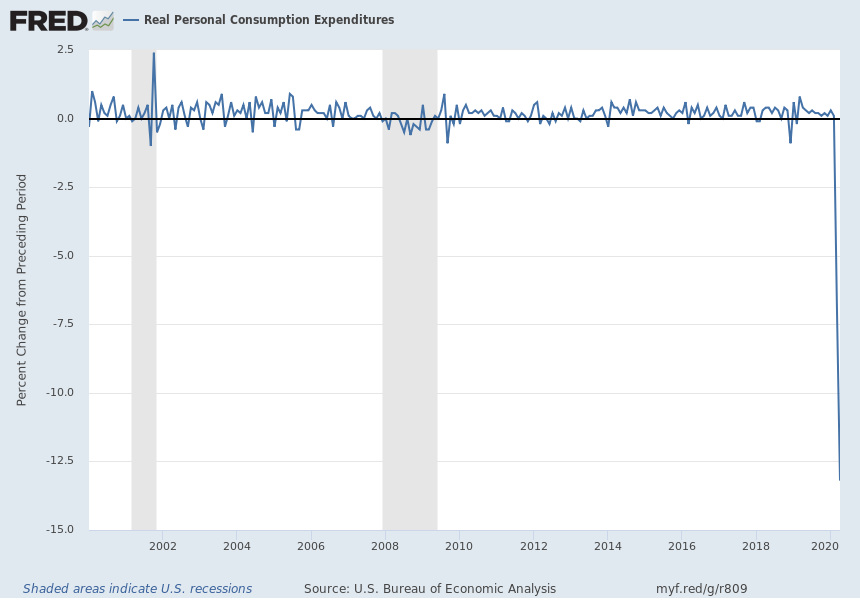
Forecasting the economy is a near impossible task in this recession because the data have no historical precedent. We thought the last recession from 2007 to 2009 was bad; but this one makes the last one look trivial. For example, look at the change in consumer spending in April compared with the change in the past two recessions.

realC

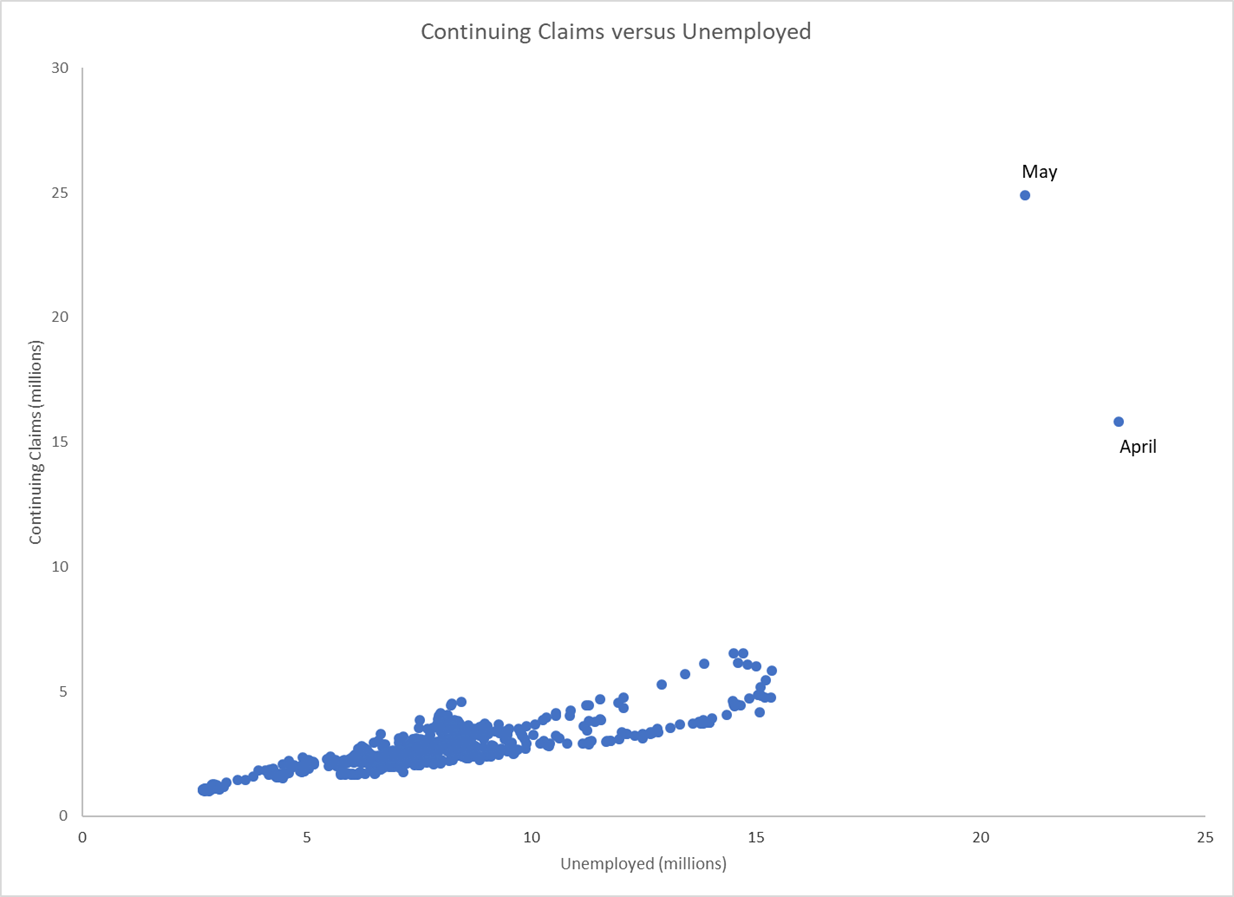
Because of the unprecedented nature of this recession, forecasting is a major challenge. Like many forecasters, my forecasts were far off for the unemployment rate in May. I expected it to be around 22 percent, but it came in just over 13 percent. I based my forecasts on the April number of nearly 15 percent, combined with a huge increase in continuing claims for unemployment insurance. But if you look at the chart comparing the continuing claims to the number of unemployed people, you can see that the numbers are so far out of our historical experience, that our econometric models are not very useful.

CCvsU

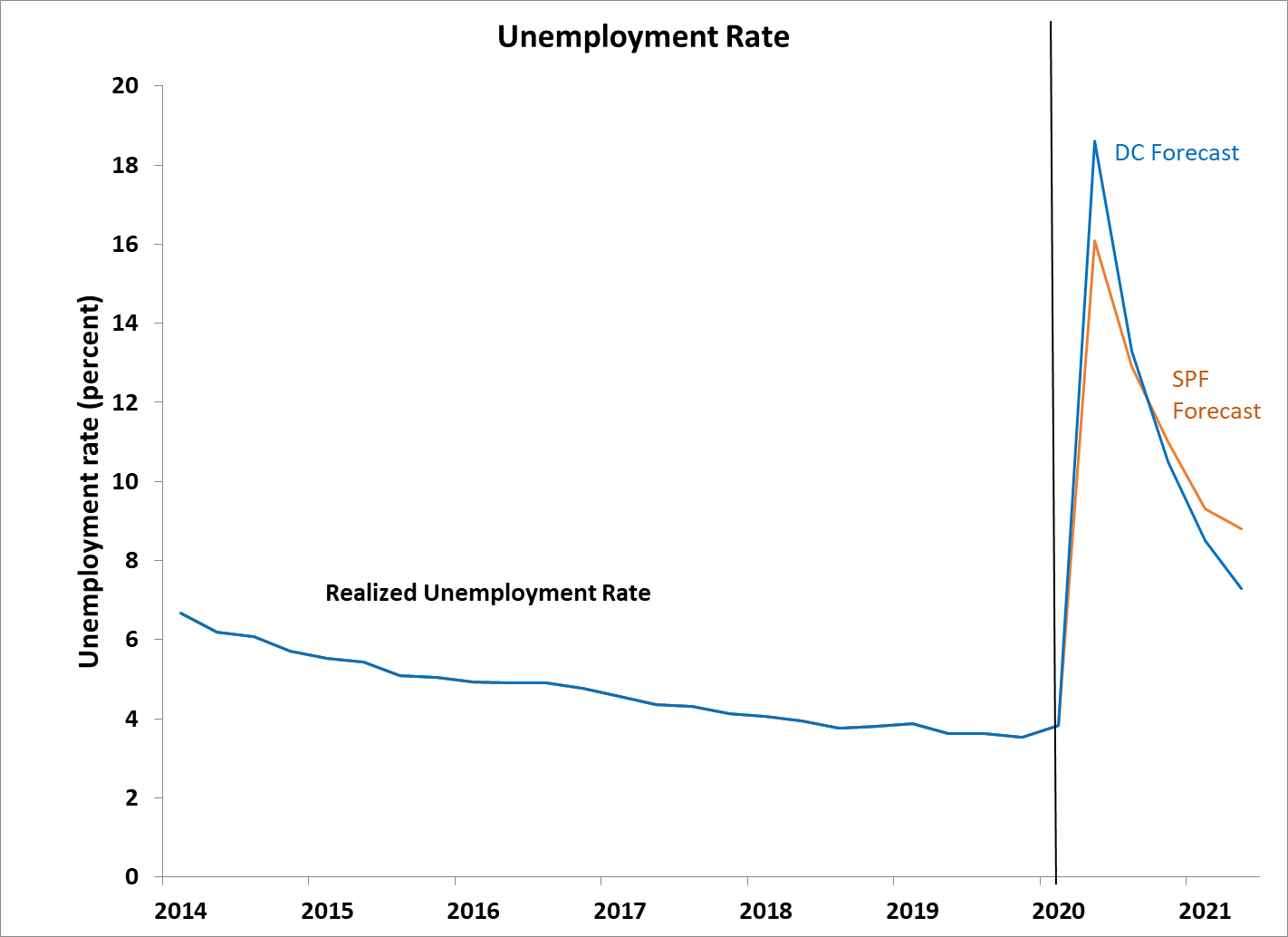
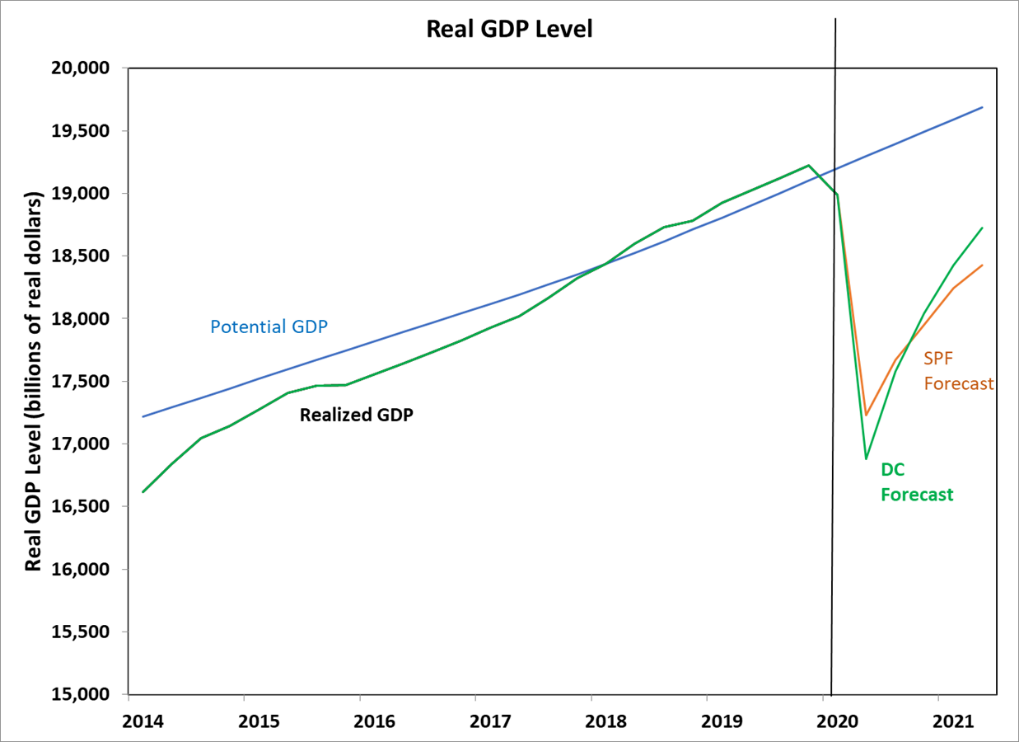
Compared with other forecasters, such as those in the Survey of Professional Forecasters, I am a bit more pessimistic in the short run but more optimistic in the long run, as my initial forecasts of real GDP growth and the unemployment rate suggested.

DCfUR

DCfGDP

These forecasts were made before the May unemployment rate was released in early June. I have subsequently revised down my unemployment rate forecasts but only because I think the BLS has a lot of errors in how people are classified and that they will continue to do so. I think the true unemployment rate is substantially higher than the BLS suggests.

Of course, all economic forecasts depend on the outcomes of the coronavirus, and no one knows how that will turn out. Thus, the error bands around all of these forecasts are much larger than ever before. In fact, my forecast for the personal saving rate in May is 30% plus or minus 20%! That’s because the personal saving rate is measured very badly, on average, and the measurement errors for most variables increase in recessions. I suspect that the data we are seeing now are going to be revised substantially, with revisions that are larger in magnitude than we have ever seen before. So, I would advise being skeptical about all macroeconomic data that you see.

The Political Business Cycle

The President’s recent pressure on the Federal Reserve is a great illustration of why we must have an independent central bank. Every incumbent politician wants the economy to be growing strongly when he or she is seeking reelection. Now, the current President has suddenly realized that he put in place expansionary fiscal policy too early, stimulating the economy in 2018. He would prefer that the economy be growing more rapidly in 2020 when he hopes to be reelected. But the transitory impact of his policies are already wearing off, so of course he wants the Federal Reserve to cut interest rates now and to further stimulate the economy.

Monetary policy works with a lag, with the maximum impact of a policy change on output and employment occurring about one year after a change in interest rates. That means that if the Federal Reserve were to cut interest rates right now, the economy would be heating up next spring and summer, just ahead of the fall elections.

Economists call the relationship between stimulative policies and elections the Political Business Cycle. Since time immemorial, politicians have striven to have macroeconomic policies help their reelection chances. That is one reason that most countries have created independent central banks, so that economic facts, not political desires, determine monetary policy.

Does the economic situation itself call for a cut in interest rates? Although a few weeks ago there was some concern about weakness in the economies of China and Germany, along with an inverted yield curve, the threat of recession seems to have subsided. In fact, this is exactly the wrong time to engage in stimulative monetary policy, as the economy seems very close to full employment, and further stimulus is likely to be inflationary. Should the U.S. labor market continue to do well, with wage pressures increasing, the threat of higher inflation might lead the Federal Reserve to raise interest rates later this year.

Earlier appointments to the Federal Reserve Board by the President were outstanding: Randal Quarles, Richard Clarida, Michelle Bowman, Marvin Goodfriend, and Nellie Liang, although the latter two were not confirmed by the Senate. Now the President is considering the appointment of two people who are totally unqualified for the job, with no expertise in monetary policy, macroeconomics, banking, or finance. This attempt to stack the Fed with political appointees to do the President’s bidding weakens the institution and is evidence of the President’s desire to create a Political Business Cycle. The Senate should refuse to confirm these candidates, to help preserve the Fed’s independence from political manipulation.

The Federal Reserve Must Raise Rates

The Federal Reserve’s credibility requires it to raise interest rates at its meeting this week. The reason is that otherwise it would appear to be giving in to the US President, who has been criticizing the Fed and blaming it for causing financial market turmoil. If the Fed does not raise interest rates in response, the President will have shown that he has power and influence over the Fed. The Fed must prove its independence.

The only justification the Fed could have to not raise interest rates at this meeting would to be a major deterioration in the world economy. There are some indications of weakening in China and Europe but not enough for the Fed to be overly concerned. The Fed has been on a trajectory of gradual tightening to bring monetary policy to a neutral position after a decade of easy money. The Fed needs to continue on this trajectory.

From an economist’s point of view, in fact, it is the President and Congress, not the Fed, that are raising interest rates. The President and Congress are using expansionary fiscal policy, with a large tax cut and increased government spending. As a result, the rapidly growing deficit is leading to higher interest rates, not the Federal Reserve. The government’s borrowing needs are putting pressure on financial markets to absorb more and more debt, which can only happen with higher long-term interest rates. The upward movement of those interest rates then requires the Fed to raise the short-term federal funds rates to keep pace. Failing to do so would lead to the Fed falling behind the curve and to higher future inflation.

Should the Fed not raise interest rates at its meeting this week, its low level of credibility will shrink even more. After the disaster of the Great Recession of 2007 to 2009, the Fed needs to do everything it can to regain the public’s trust. An increase in interest rates would help. If the first quarter inflation numbers rise, as seems likely, the Fed will need to raise interest rates even faster in 2019 than it did in 2018.

Fed Chair Powell may have the respect of economists within the Fed but has no credibility outside the Federal Reserve System. It is time for him to change that.

Why Low Inflation Is Good for You

Fifty years ago, economists didn’t think that inflation caused many economic problems. Then, in the late 1960s and throughout the 1970s, inflation rose to double-digit levels in the United States and many other countries. We learned that the costs of inflation may be significant and that a low inflation rate is ideal.

The problems caused by inflation can be divided into two parts: one based on the level of inflation itself (that is, an inflation rate of 8% is worse than an inflation rate of 2%) and another based on uncertainty about inflation (that is, a situation in which you don’t know if the inflation rate will be 3% or 5% is worse than a situation with a known inflation rate of 4%).

Problems Caused by Inflation

Inflation creates a number of problems for the economy: (1) shoe-leather costs; (2) menu costs; (3) imperfect taxation; and (4) a tilt in mortgage payments.

The first cost of inflation is what economists call shoe-leather costs, which is a euphemism for the costs that society incurs when people go to the bank frequently as they try to keep less cash in their pockets. When inflation occurs, your cash loses value because it earns no interest. If inflation is 10% and you keep $100 in your wallet, on average, you lose $10 each year in purchasing power. To minimize that cost, you might go to the bank more often and keep less cash in your wallet. The cost to individuals is fairly small, but for business firms that might have millions of dollars in cash outstanding, for example at retail stores, these costs can be quite high.

A second important cost of inflation is menu costs. These costs arise because inflation causes firms to have to change their prices frequently. The most obvious cost is for restaurants that may have fancy menus that are expensive to produce. Many other firms face this cost, especially firms that list their prices in large catalogues. Customers don’t like it when prices are constantly changing and firms cannot honor the prices they have printed in their catalogues. This problem is mitigated somewhat if the prices are only shown on the firm’s web site because those prices can be changed quickly, but the problem remains significant for many firms.

The third problem with inflation, which is even more significant, is that our tax system is distorted significantly by the presence of inflation. The higher the inflation rate is, the bigger the distortion is. The cost of a 6% inflation rate is more than twice the cost of a 3% inflation rate. The source of the problem is that the U.S. tax system is based entirely on dollar amounts. But the economic system is based on inflation-adjusted amounts. Those two systems clash strongly when inflation occurs.

Here is an example. Suppose you invest $10,000 in a stock that pays a 5% inflation-adjusted return each year and suppose you are in the 40% tax bracket (combining U.S., state, and local income taxes). If inflation is 0% and the inflation-adjusted return is 5%, then you earn a dollar return of 5% (note that the inflation-adjusted return plus the inflation rate equals the return in terms of dollars, so 5% + 0% = 5%). In dollars, you earn 5% × $10,000 = $500. Your tax will be 40% of the $500 return, which is 0.4 × $500 = $200. So, of the $500 that you earned, you get to keep $300 and the government keeps $200.

But what if the inflation rate is 10%? If you get the same inflation-adjusted return of 5%, the return on your investment is 15% in terms of dollars (5% inflation-adjusted return + 10% inflation = 15% return in dollar terms). In dollar terms, you earn 0.15 × $10,000 = $1,500. Now you are taxed 40% on your dollar return, so you will pay taxes of 0.4 × $1,500 = $600. You earn $900 after taxes and pay $600 in taxes. You might think that is fine, but now calculate how much the value of your stock has declined because of inflation. With a 10% inflation rate, your $10,000 worth of stock is now worth $1,000 less. So, in inflation-adjusted terms, your return is actually negative. In dollar terms, you got a $900 return but the value of your investment fell by $1,000, so your inflation-adjusted return is –$100, or –1%.

Why is your return negative? The main reason is that the government taxed you on the dollar amount of your return, rather than the inflation-adjusted amount of your return. One way to look at it is that of the 15% return in dollar terms that your stock generated, inflation got 10% of it, the government got 6% of it, and you got –1% of it; or in inflation-adjusted terms, the government gets 6% and you get –1% of the total inflation-adjusted return of 5%.

So, the higher inflation is, the more the government gets of your income and the less you get. That’s why sometimes governments create inflation to get out of budget problems—they get much more tax revenue and the inflation-adjusted value of their debt declines.

The fourth and final major problem related to inflation is that it distorts people’s mortgage payments. This is another fairly subtle problem that most people don’t realize is happening. The basic idea is that, the higher inflation is, the higher the mortgage interest rate is, and the inflation-adjusted value of your mortgage payment declines over time. This means that it costs you much more in inflation-adjusted terms to pay your mortgage early on and much less later. Here is an example.

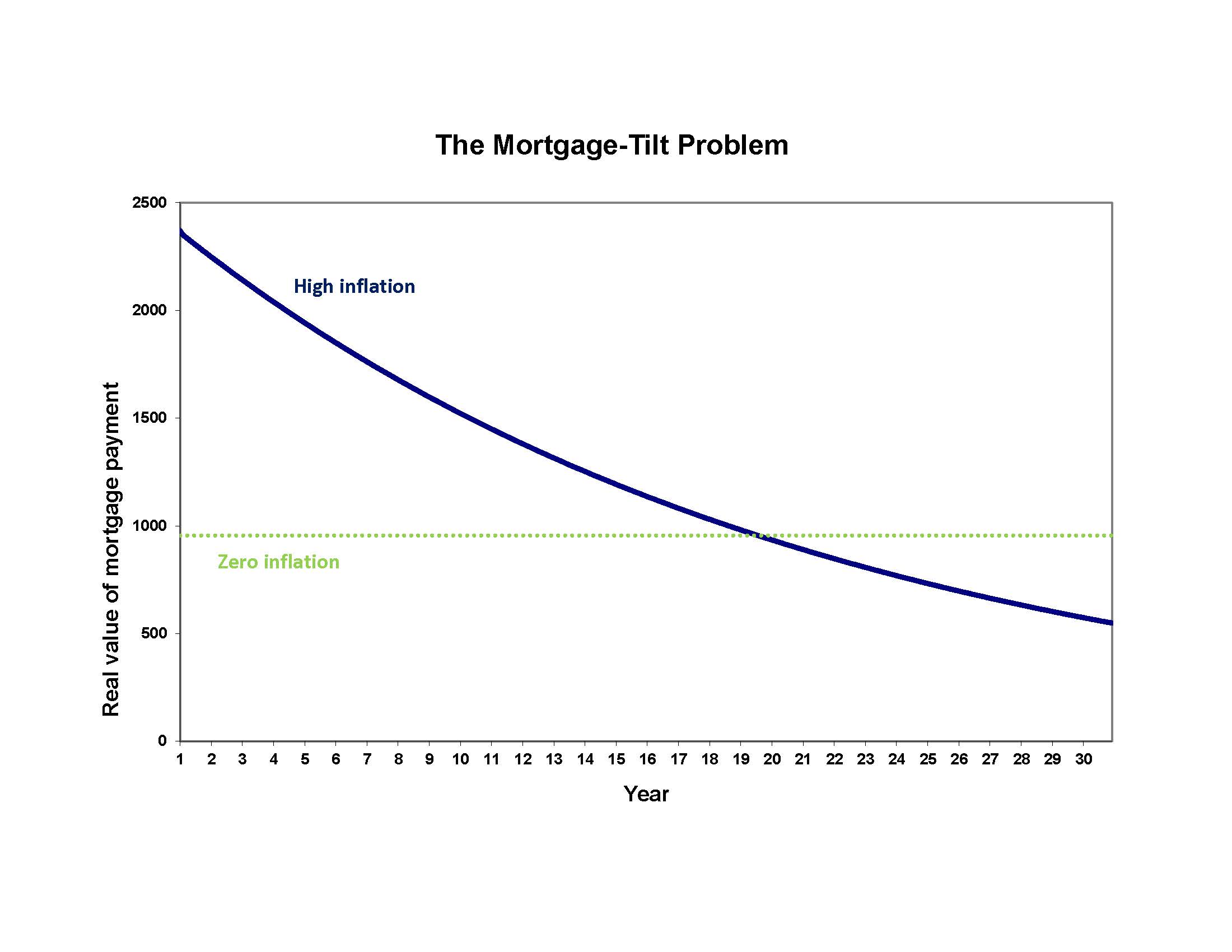
Consider two situations, one in which inflation is 0% and one in which the inflation rate is 10%. In the low inflation case, suppose your mortgage interest rate is 4% but in the high inflation case it is 14%, so in both cases the mortgage interest rate equals 4% plus the inflation rate. How much would your monthly payment be on a $200,000 30-year mortgage? If inflation is 0%, your monthly payment would be $954.83. If inflation is 10%, your monthly payment would be $2369.74. Your monthly payment on your mortgage is much higher when inflation is 10% than if inflation is 0%. When you combine this with the fact that to qualify for a mortgage your monthly mortgage and total debt payments must not exceed a certain fraction of your income, you can see that when inflation is high, homebuyers will have to buy smaller homes to keep the monthly payments affordable. This problem is aggravated by the mortgage-tilt problem, which is illustrated in the next chart.

mortgage tilt

Chart: The Mortgage-Tilt Problem

Source: Author’s calculations

As the chart shows, when inflation is zero, the real (inflation-adjusted) value of the monthly mortgage payments is constant over time. But when inflation is high (10% in this case), the monthly payments are tilted; they are high early in the life of the mortgage and lower later in the life of the loan. This mortgage tilt creates a problem because you qualify for a loan based on the initial payment. So, when inflation is high, your mortgage is least affordable in the early years, and much more affordable in the past 10 years. But the result is that you may have to buy a smaller home when inflation is high because of the mortgage-tilt problem.

How to Adjust for Inflation

I was teaching a class in April 2013, and I started, as I usually do, by talking about the economic news of the past week and what it meant for the economy. A student said, “I thought the big news of the week was that the stock market had hit a new high level, surpassing the level it had been at before the financial crisis in 2008.” He was excited about that, as were many of the other students, most of whom worked on Wall Street. My reply was depressing to my students, but accurate, as I noted, “Although the news media trumpeted the new level of the stock market, they failed to account for inflation. Once you do that, you’ll see that the market still needs to rise another 7% or so before it is as high as it was in 2008 before the crisis.” I then proceeded to show them how to account for inflation properly, to see economic variables in real, not nominal terms.

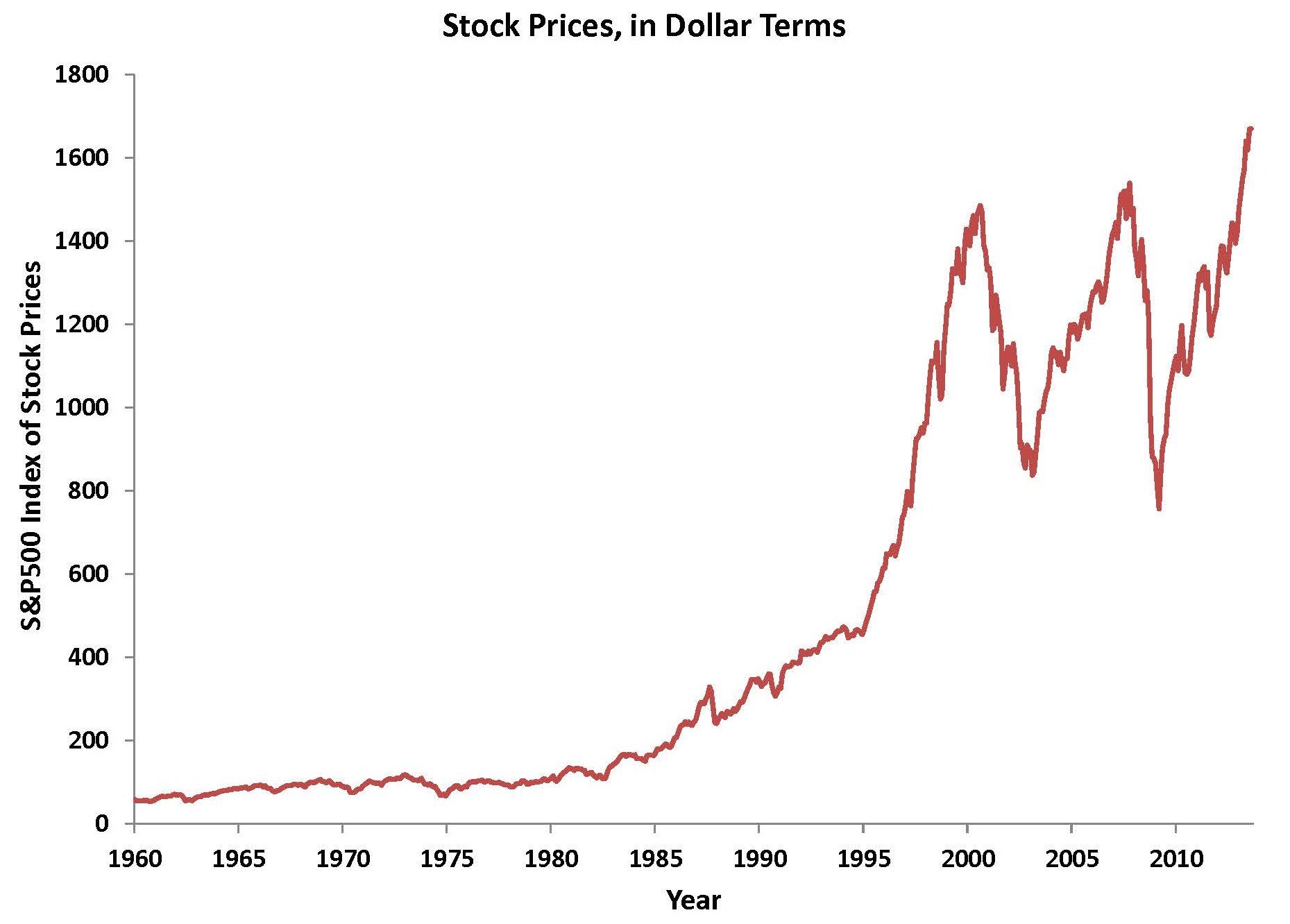
The first chart shows a view of the stock market’s value in nominal terms (the dollar value of the market). You can see that in the past 15 years, the market reached local peaks in August 2000, October 2007, and August 2013. Before the financial crisis, in October 2007, the market (measured by the monthly average of the Standard & Poor’s 500 index of stock prices) stood at a level of 1539. As of August 2013, the index was 1670, which is 8% higher than it was in October 2007.

nominal stock prices

Chart: Stock Prices, in Dollar Terms

Source: S&P Dow Jones Indices LLC, S&P 500© [SP500], retrieved from FRED, Federal Reserve Bank of St. Louis; https://fred.stlouisfed.org/series/SP500, May 1, 2017.


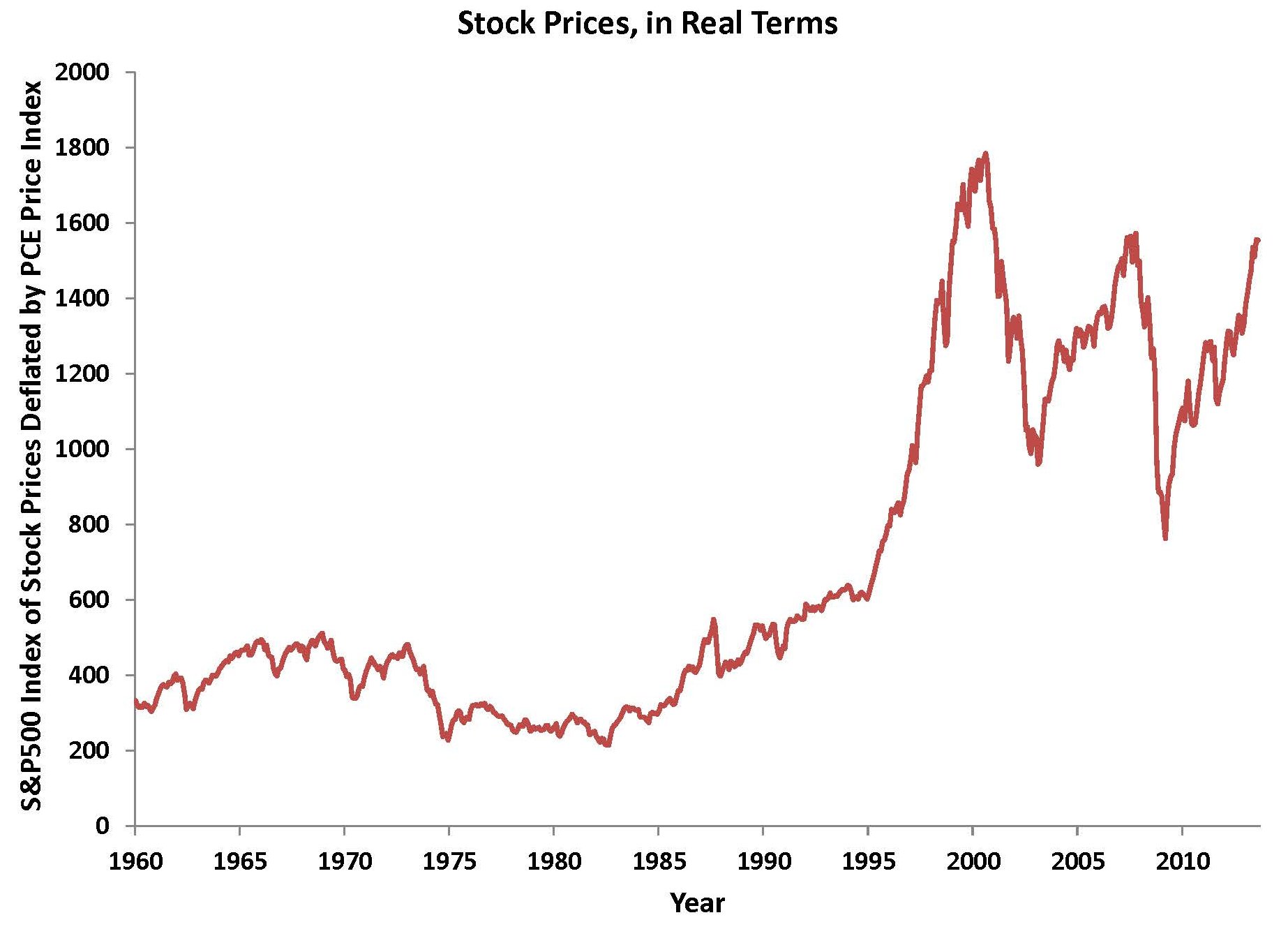
But remember that the dollar doesn’t buy what it used to buy. As we saw earlier, one dollar in 1965 buys the same amount of goods that $6 buys today. To get an accurate picture of the value of the stock market, we must adjust for inflation. The adjustment is not too complicated.  All you have to do is to divide the nominal (dollar) value of the stock market at each date by a measure of prices at that date. Doing so creates a real (inflation adjusted) index of the stock market, as shown in the next chart. To create the chart, I used the personal consumption expenditures price index as my index of inflation.

real stock prices

Chart: Stock Prices, in Real Terms

Source: Author’s calculations using data on S&P 500 Index and PCE price index (Bureau of Economic Analysis)


As you can see in this chart, adjusting for inflation matters a lot. You can see that the peaks in the market that we observed in nominal terms in 2007 and 2013 are well below the real level of the stock market in 2000. And, as of August 2013, the market was still 13% below its level in August 2000, in real terms.

The same idea can be applied in many other ways. Any nominal (dollar-denominated) variable can be adjusted for inflation to put it in real (inflation adjusted) terms. You might think your salary has been growing pretty well over time, but have you adjusted it for inflation? Over the past 16 years, nominal wages and salaries in the United States have gone up 2.7% per year, on average, but most of that rise was just to keep up with inflation. In real terms, wages and salaries have gone up only 0.9%, as inflation in consumer prices has averaged 1.8%. Similarly, we measure total U.S. output with GDP (gross domestic product). GDP has increased 3.8% in the past 16 years, but has increased only 1.8% in real terms (using a measure of inflation based on all prices of goods produced in the United States).

So, be sure to adjust for inflation whenever you are dealing with dollar figures, and don’t be fooled by inflation!

Inflation: The Impact of Food and Energy Prices

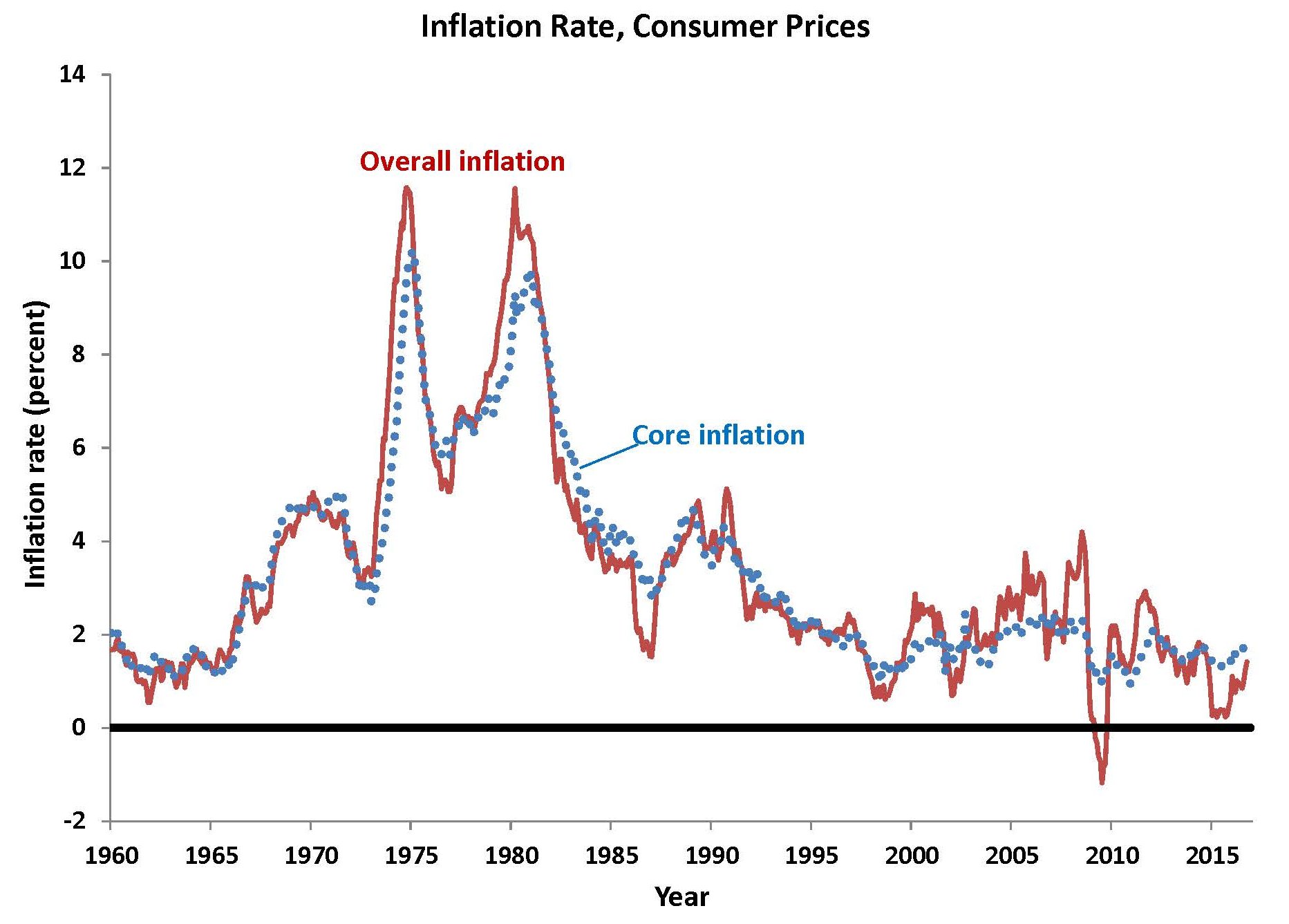
In the short run, oil prices have a major impact on inflation. But it is usually only a short-run effect and on only a few occasions has a spike in oil prices carried over into other prices since 1981. In a few years, a spike in food prices, rather than oil prices, has caused a jump in inflation. One way to see what inflation is doing while abstracting from oil prices and food prices is to calculate the inflation rate based on all goods and services except food and energy prices. This is shown as the dotted line in the chart, labeled “Core inflation”.

overall-versus-core-inflation

Chart: Inflation Rate, Consumer Prices

Source: Author’s calculations, based on Bureau of Economic Analysis data on personal consumption expenditures price index and the same index excluding food and energy prices (core inflation).


You can see immediately that core inflation is much smoother and less volatile than overall inflation. Core inflation is noticeably lower than overall inflation in the years of the oil-price shocks, such as 1974-1975, 1979-1980, and 2004-2005. In a few cases, oil prices declined and you see that core inflation is higher than overall inflation, such as in 1986. You can also see that much of the rise in overall inflation from 2004 to 2008 was driven by increases in food and (especially) energy prices. In a sense, the core inflation measure is the one to focus on because it gives us a better sense of overall inflation, abstracting from short-term shocks to food and energy prices. Although looking at the core inflation rate gets rid of short-term volatility and is thus more useful as an indicator for future inflation, the prices we pay for goods and services are measured by the overall inflation rate, so that’s the one that you want to look at to understand how much the dollar’s value has changed over long periods of time.

Because food and energy prices are so volatile, the policymakers at the Federal Reserve, who are in charge of keeping inflation low and stable, focus mainly on core inflation in setting policy. They know that if they were to respond to every shock up or down in the overall inflation rate, they would be changing interest rates far more often than is warranted. So, although they care about overall inflation in the long run, they know that in the short run their policy actions should be dependent on core inflation, not overall inflation.